
An agile retrospective is a structured meeting held at the end of each sprint where the team reflects on how they worked, not just what they shipped. It is the single most consistent improvement habit in software development.
Run well, a retrospective surfaces friction early, builds team trust, and produces concrete process changes. Run poorly, it becomes a 45-minute gripe session that changes nothing.
This guide covers what retrospectives are, why they matter, how to run them step by step, and the most common formats agile teams use.
What is an agile retrospective?
A retrospective (often shortened to "retro") is a time-boxed meeting, typically 60–90 minutes, where the team reflects on the previous sprint. It is one of the four Scrum ceremonies, alongside Sprint Planning, the Daily Standup, and the Sprint Review.
The goal is continuous improvement: getting better at how you work, not just what you ship.
Three questions frame almost every retrospective:
- What went well?
- What could be improved?
- What will we do differently next sprint?
The third question matters most. A retrospective without action items is just a conversation. The output should always be a short list of concrete changes, with owners and deadlines, that the team commits to next sprint.
Why run retrospectives?
Teams that skip retrospectives tend to repeat the same problems. The issue that slowed down sprint 3 is still there in sprint 7; everyone has just adapted around it.
Retrospectives break that cycle. They give the team a dedicated space to:
- Surface friction that doesn't come up in daily standups
- Fix processes before they calcify into permanent workarounds
- Acknowledge what's working before it gets accidentally changed
- Build trust by practising honest conversation in a structured setting
The best teams treat retrospectives as a habit: something you do consistently, not just when things go wrong.
How often should you run a retrospective?
Most Scrum teams hold a retrospective at the end of every sprint, typically every one to four weeks. Kanban teams often run a cadence-based retro (monthly or fortnightly) instead.
Frequency matters less than consistency. Irregular retrospectives are harder to take seriously and harder to act on.
If your team is new or going through significant change, lean towards more frequent retros. A 30-minute lightweight check-in every sprint is more valuable than a 90-minute deep-dive every six weeks.
How to run an agile retrospective
1. Set the stage (5–10 minutes)
Open with a brief check-in. Ask everyone a simple question to kick things off: "In one word, how are you feeling about this sprint?" It gets quieter team members talking early and is especially useful in remote or hybrid sessions where you can't read body language.
TeleRetro's AI Icebreaker Bot generates questions suited to your team's mood if you want something more creative.
2. Gather data (15–20 minutes)
Ask the team to add cards to the board. Switch on anonymous brainstorming mode so everyone writes privately, without being influenced by what others are adding.
This is where the chosen format shapes what surfaces. A Sailboat retro asks for wind (what helped), anchors (what slowed you), rocks (risks), and the island (your goal). A Mad Sad Glad asks the team to describe the sprint emotionally. Different formats draw out different conversations.
TeleRetro has 50+ retro formats and templates to suit different team moods, sprint types, and experience levels.
3. Generate insights (20–25 minutes)
Group similar cards. Use anonymous voting to surface the themes that matter most to the team. Spend the bulk of the meeting on the top two or three clusters.
The goal in this phase is understanding why something happened, not just that it did. "Deployments were slow" is an observation. "Deployments were slow because we still don't have automated staging checks" is an insight worth acting on.
4. Decide what to do (10–15 minutes)
For each priority theme, agree on one concrete action. Actions need an owner and a deadline, ideally resolved within the next sprint.
TeleRetro's action item tracking carries actions from retro to retro so nothing gets lost. Teams that track actions follow through far more often than those who rely on memory or meeting notes.
5. Close the retrospective (5 minutes)
End with something brief: a round-the-room thank-you, a 1–5 rating of the retro itself, or simply reading out the action items aloud. Closing matters. It signals the session was worthwhile and reinforces the habit.
Common retrospective formats
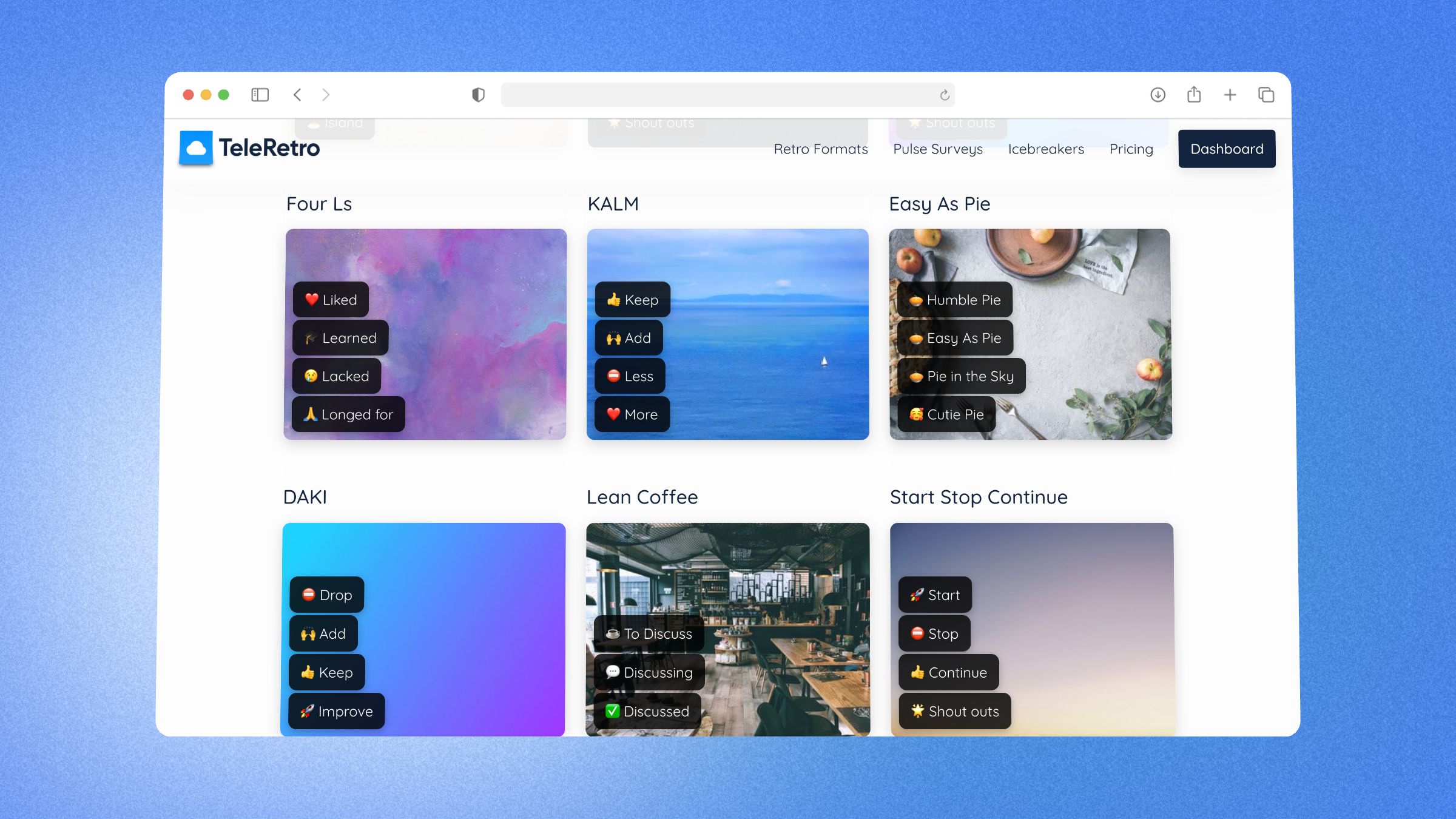
Different formats draw out different kinds of conversation. Some common ones:
- Start, Stop, Continue: Direct and action-oriented. Best for experienced teams who know each other well.
- Mad, Sad, Glad: Emotions-first. Good for teams processing a difficult or high-pressure sprint.
- Sailboat: Visual metaphor. Works well with mixed groups and teams new to retrospectives.
- 4 Ls: Liked, Learned, Lacked, Longed For. Strong for learning-oriented teams.
- DAKI: Drop, Add, Keep, Improve. Sharp and action-focused.
- Lean Coffee: Team-owned agenda. Good when the team has specific topics they want to drive.
Not sure which format fits your team right now? TeleRetro's Retro Bot suggests one based on your team's context.
Common mistakes to avoid
Running the retro with an audience. Retrospectives are for the team. Managers, product owners, and stakeholders should generally not attend. Their presence changes what people say.
Action items without owners. "We should improve the CI pipeline" is not an action. "Maya will investigate parallelising the test suite by next Wednesday" is.
Same format every sprint. Rotating formats keeps the conversation fresh and surfaces different kinds of observations.
Skipping retrospectives when things are going well. That's exactly when it's easiest to have an honest, forward-looking conversation.
Ignoring previous action items. Open each retrospective by reviewing what was committed to last time. Teams that don't do this lose credibility in their own process.
Frequently asked questions
Who should facilitate an agile retrospective?
In Scrum, the Scrum Master typically facilitates. In teams without a dedicated Scrum Master, any team member can do it, and rotating the facilitator role can itself improve participation. The facilitator's job is to keep the session moving and ensure quieter voices are heard, not to drive the outcomes.
How long should a retrospective be?
The Scrum Guide suggests one hour per week of sprint length, so a two-week sprint warrants up to a two-hour retro. In practice, most teams find 60–75 minutes sufficient, especially if the team is experienced and action items from previous retros are already visible before the session starts.
Can you run a retrospective remotely?
Yes, and remote retrospectives can be more effective than in-person ones when facilitated well. Anonymous digital boards reduce the social dynamics that suppress honesty in a room. Icebreaker music helps set the tone when you can't rely on a shared physical space.
What's the difference between a retrospective and a sprint review?
The sprint review is about the product: what got built, what stakeholders think, and what comes next in the backlog. The retrospective is about the team: how you worked together, what slowed you down, and what to change. They are separate meetings with different participants and different outputs.
How do you handle it when the same issues come up every sprint?
That's a signal worth naming directly. If the same item appears three sprints running, it's either a systemic problem that needs a bigger fix, possibly outside the team's control, or the agreed action items aren't sticking. Raise it: "We've flagged this three times. What's actually blocking us from fixing it?"
Updated
Experience a better retro
Create a retro in seconds & see for yourself.